Unaspected Planets

Author: Ori Olwardt
In a natal chart, the existence of aspects between planets is the norm. If we consider the major aspects with an 8° orb, the estimated probability of one specific planet forming an aspect with another specific planet is roughly 35.6%—approaching 40%.
When we consider whether a single planet makes an aspect to any of the other nine planets, we are essentially calculating this probability nine times. Imagine flipping a coin nine times: even if the probability of "heads" drops by 10%, getting at least one "heads" (an aspect) is almost inevitable.
So, suppose the coin truly comes up "tails" nine times in a row—meaning a planet forms absolutely no major aspects with the other nine planets. What is the estimated probability of this occurring?
The calculation is straightforward:
P (No aspect with 9 planets) = P (No aspect with 1 planet) ^ 9
= (1 - 0.356) ^ 9
= 0.0190…
1.90%
This rare phenomenon is what we are discussing today: The Unaspected Planet.
Definition and Function
As mentioned above, an unaspected planet refers to a planet that forms no major aspects (Conjunction, Sextile, Square, Trine, or Opposition) with the other nine planets. This concept likely originated in Hellenistic astrology, though at that time, astrologers were more concerned with the "Void of Course" Moon for electional judgments.
In modern times, the concept was popularized largely by the renowned astrologer Noel Tyl in his works. Specifically, we can understand its characteristics from the following perspectives:
Purity & Power
Aspects act as a form of "coloring" or modification—more precisely, a limitation—for a planet. If Venus aspects Saturn, its "Love" takes on realistic considerations; a Venus aspected by Saturn will have a sense of "Beauty" that leans towards rational analysis.
But what happens if we strip away all these modifying aspects? What does the sentence become?
It is simply "Love." It is purely "Beauty." An unaspected Venus refuses all external definitions and compromises. It is not a "Venus that tends toward X"; it is Venus in its most unadulterated form. It represents the very essence of values and aesthetics.
Because this raw, concentrated energy is not distributed, diluted, or negotiated with other planets, it can develop into astonishing talent and brilliance, granting the native immense, laser-focused potential in the domain governed by that planet.
Isolation & Latency
There is a prevailing consensus in modern astrological discourse that, due to its lack of connection with the rest of the chart, an unaspected planet typically manifests in two extreme states.
It is either completely dormant, hovering in the background where the native barely registers its existence; or, when suddenly triggered by transits, it erupts completely. It acts as an unstoppable "geyser" of energy that catches both the native and everyone around them completely off guard.
Personal Insights
I largely agree with the points above: purity, power, astonishing talent, and the pattern of long silence followed by sudden eruption. These are indeed the common manifestations of unaspected planets. However, based on practical chart reading, I would like to add a few critical nuances:
Hidden ≠ Non-existent
The term "hidden" can sometimes lead to misunderstandings. In reality, the themes and events associated with an unaspected planet are often perceived deeply and intensely by the native. Rather than being absent, serving to profoundly shape the very foundation of their personality.
Regarding physical events, the pattern of "long silence followed by a transit-induced eruption" is valid. However, we must correct a common misconception about the frequency of these eruptions. Because unaspected planets rely heavily on major Outer Planet transits to be activated, people assume these events are rare. But opportunities for activation are far more frequent than one might think.
Consider the math of transits: Jupiter completes a circuit every 12 years; Saturn every 28 years. Even by adolescence, the specific degree of that unaspected planet has already been "pinged" multiple times via conjunctions, squares, or oppositions from these slower-moving giants.
Let’s imagine a practical scenario: A native has an unaspected Mars in the 11th House (friends/networks). Every time a heavy outer planet activates it, the native experiences an intense, earth-shattering conflict within their social circle.
When we factor in the five triggering outer planets (Jupiter, Saturn, Uranus, Neptune, Pluto), and layer on traditional time-lord techniques like Profections or Zodiacal Releasing, we can conservatively estimate that this Mars is powerfully activated at least once a year.
If a person has a dramatic, bridge-burning quarrel with friends every single year, is it really just "sporadic bad luck," or is that unaspected Mars actively making the person a consistent "troublemaker"? The energy is always there; it just lacks a healthy daily outlet.
Unaspected Generational Planets
Another common misconception is that an unaspected generational (outer) planet is merely a "generational signature," is impersonal, and therefore requires no interpretation. I find this claim doubtful.
We must understand that while generational planets stay in a sign for years (making the sign placement less personal), they become deeply personal when placed in a specific House (which changes every 2 hours) or when connected to personal planets.
The same logic applies to unaspected planets. The probability of an outer planet being unaspected is not drastically different from inner planets. Even if an outer planet moves slowly itself, it is still subject to the rapid "sweeping beams" of the faster-moving personal planets. Therefore, an unaspected outer planet must be interpreted. Furthermore, because the archetypes of the outer planets are so overpowering, when they are focused purely on an individual chart, they demand significant attention.
Watch the Ruled House
An unaspected planet cannot establish connections with other planets via aspects. Therefore, the House it rules, and any planets residing in that House, become the only recipients of this powerful, unadulterated energy.
This concept of dispositorship is an incredibly useful key for unlocking the planet's real-world manifestation, as we will demonstrate in the forthcoming case analyses.
Case Studies
Let’s begin with a 20th-century icon of civil rights:
Martin Luther King Jr.
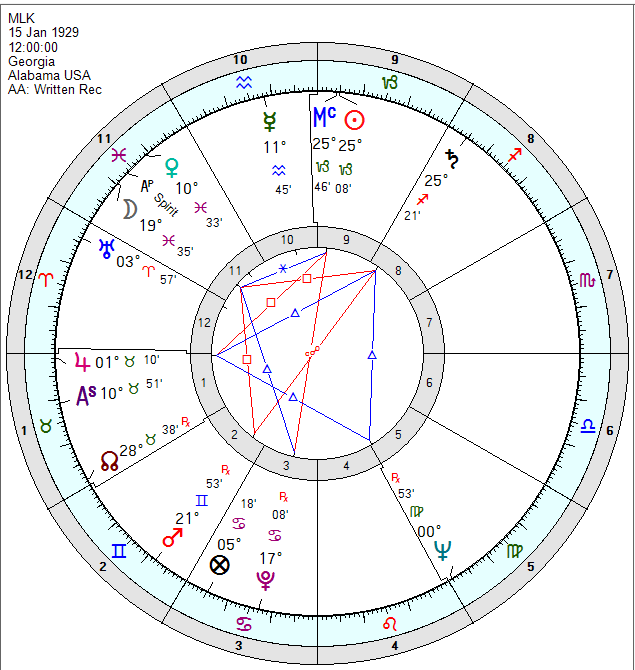
Dr. King’s life was the profound, literal embodiment of his iconic words, "I have a dream." He dedicated his existence to the civil rights movement and, later, to broader anti-poverty and anti-war causes. In his natal chart, this extraordinary life path points clearly to an unaspected Venus in Pisces in the 11th House.
Venus, the planet representing love and values, is exalted here, endowed with the boundless, unconditional compassion of Pisces. It is directed toward the 11th House of community, societal ideals, and the collective future of humanity.
Because it is unaspected, this energy is not "interfered with," negotiated, or compromised by the pragmatic demands of other planets. It manifests in its absolute purest, most idealistic form: unconditional, universal love.
As mentioned earlier, what truly integrated this celestial energy into the very core of his life was a brilliant Mutual Reception with Jupiter. Pisces is traditionally ruled by Jupiter, and Dr. King's Jupiter is placed in his 1st House (Self/Identity) in Taurus—a sign ruled by Venus.
This elegant astrological loop allowed his unconditional love for the human community (Venus in the 11th) to form a natural, seamless feedback system with his core identity and physical presence (Jupiter in the 1st). The unaspected Venus found its perfect outlet, enabling him to become the living, breathing avatar of that universal love.
Marilyn Monroe
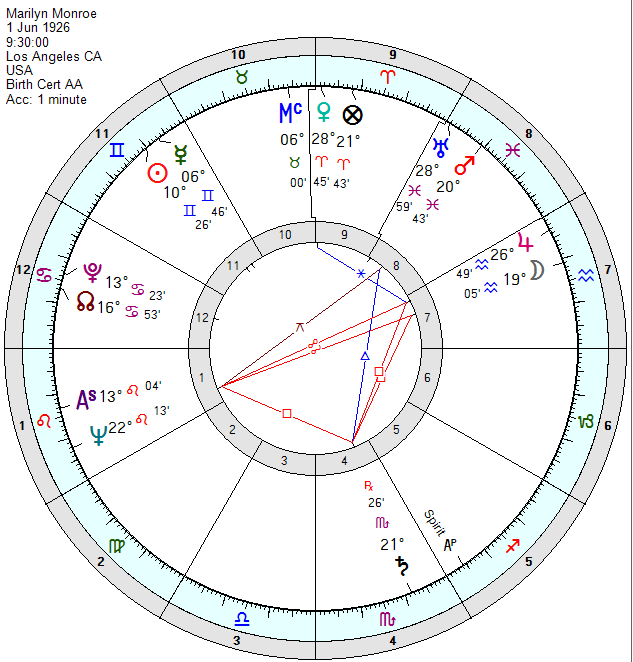
Unlike Dr. King’s inspiring script, Monroe’s life was colored by tragedy, centered on the trauma of a disastrous childhood she could never escape.
Her Pluto is in Cancer in the 12th House, and it is unaspected. Pluto symbolizes crisis and trauma; Cancer relates to family and emotional security; the 12th House is the realm of the hidden and the unconscious. The "unaspected" condition acted as a disaster engine, becoming the root of her lifelong panic and anxiety.
As noted in my insights, the influence of an unaspected planet extends beyond its placement. It heavily impacts the House it rules—in her case via ruulership of Scorpio, the 4th House (Home/Family). While her 4th House already contained a difficult Saturn-Moon-Neptune T-Square (foreshadowing the collapse of her family life), the intervention of this unaspected Pluto reveals the deeper layer of catastrophic pain she endured.
Vincent van Gogh
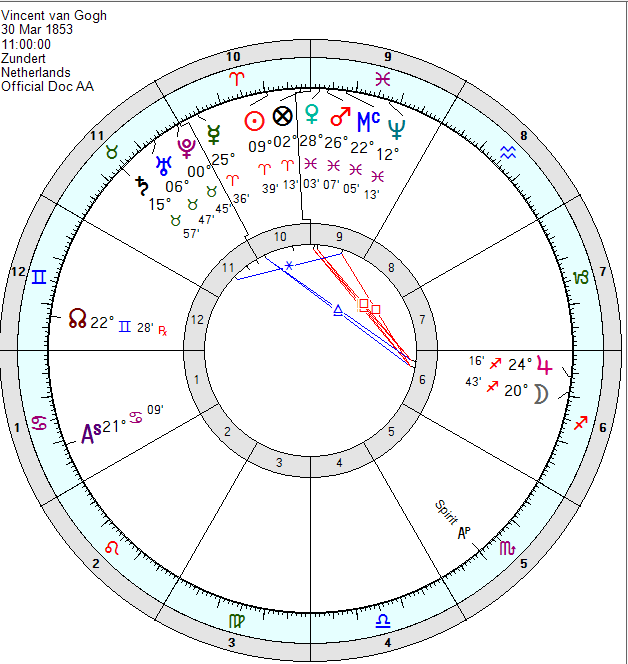
For one of history’s greatest painters, the chart is even more extreme. His Sun—the source of life—is Exalted in Aries, placed in the powerful 10th House (Angular), and is unaspected.
This validates the view that an unaspected planet is not "low visibility" but rather a massive component of the life force. This solar configuration undoubtedly represents extreme vitality, impulsiveness, and a burning fanaticism—traits that structured the entirety of Van Gogh’s personality.
Before becoming a painter, he was a near-fanatical religious devotee. He went to the impoverished Borinage mining district in Belgium as a preacher, giving away his bed, food, and even clothes to the miners.
When he turned to art, that passion only intensified. Even while starving and freezing, he would stubbornly consume nearly 3 francs (approx. $70-140 USD) worth of paint daily for his work.
Why this specific financial behavior? His Sun rules the 2nd House (Money/Values) in Leo. This astrological mechanism aligned his financial concepts perfectly with his core personality: impulsive, uncompromising, extreme, and fiercely passionate.
Anonymous Case
Finally, let’s look at an anonymous client (chart not shown by request).
The client has an unaspected Uranus in Pisces in the 8th House. This is a combination steep in mysticism: Uranus represents sudden enlightenment and subversion; the 8th House governs metaphysics, the occult, and deep psychological insight.
This pure, unadulterated Uranian energy of mutation and creativity manifested during their adolescence as sudden, serendipitous encounters with Astrology and Tarot. (For instance, a psychologist they knew turned out to be from a family of occultists). When discussing complex topics with me, this client frequently offers incredibly original, piercing insights that defy conventional logic.
So, we see a typical "occult enthusiast" configuration. But why did they develop this into a one-on-one consulting career rather than just a hobby?
As you might have guessed: the Ruled House. Uranus is the modern ruler of Aquarius. In this client's chart, the 7th House (One-on-One Relationships/Consulting/Partnerships) is in Aquarius.
This means that this powerful, independent, original Uranian energy (isolated in the 8th) has its final, definitive outlet channeled directly into "one-on-one consulting relationships" (the 7th). Furthermore, both their Sun and Mercury are located in this 7th House, ready to process and communicate that Uranian insight.
If we didn't understand that an unaspected planet desperately seeks an exit through the house it rules, we would struggle to accurately distinguish why someone with this placement naturally gravitated toward becoming a professional consultant rather than merely a solitary practitioner or a content creator.
Final Thoughts…
That brings us to the end of this post. I hope it has provided you with a new perspective on chart interpretation. If you are interested in my articles and future research, please leave your email address to subscribe for updates.
Thank you for reading, and happy chart-casting!