Zodiacal Releasing

Tag:
Hellenistic Astrology, Whole Sign, Zodiacal Releasing, Celebrity Chart
Author: Ori Olwardt
Throughout my journey into the mystical arts, I’ve always been a staunch believer in "learning by doing." As a highly practice-oriented discipline, divination shares fundamental similarities with language acquisition.
You don’t master a language by memorizing a dictionary cover-to-cover; you immerse yourself in vast amounts of input and output, allowing your brain to naturally internalize the expressions and underlying logic.
Similarly, the most effective way to learn a divinatory art is to continuously engage with its symbols. You make predictions, and when you stumble over a meaning, you consult your resources, cementing your knowledge through a constant stream of feedback.
Using this immersive method, I internalized the archetypal meanings of all 78 Rider-Waite Tarot cards in just two weeks. Within a month, I was already receiving a steady flow of positive feedback and client referrals.
So, naturally, on the third day of my astrology studies, I attempted to apply the same approach. I asked my teacher a simple question: "How can I tell if I'll see financial progress next year?"
This was her answer:
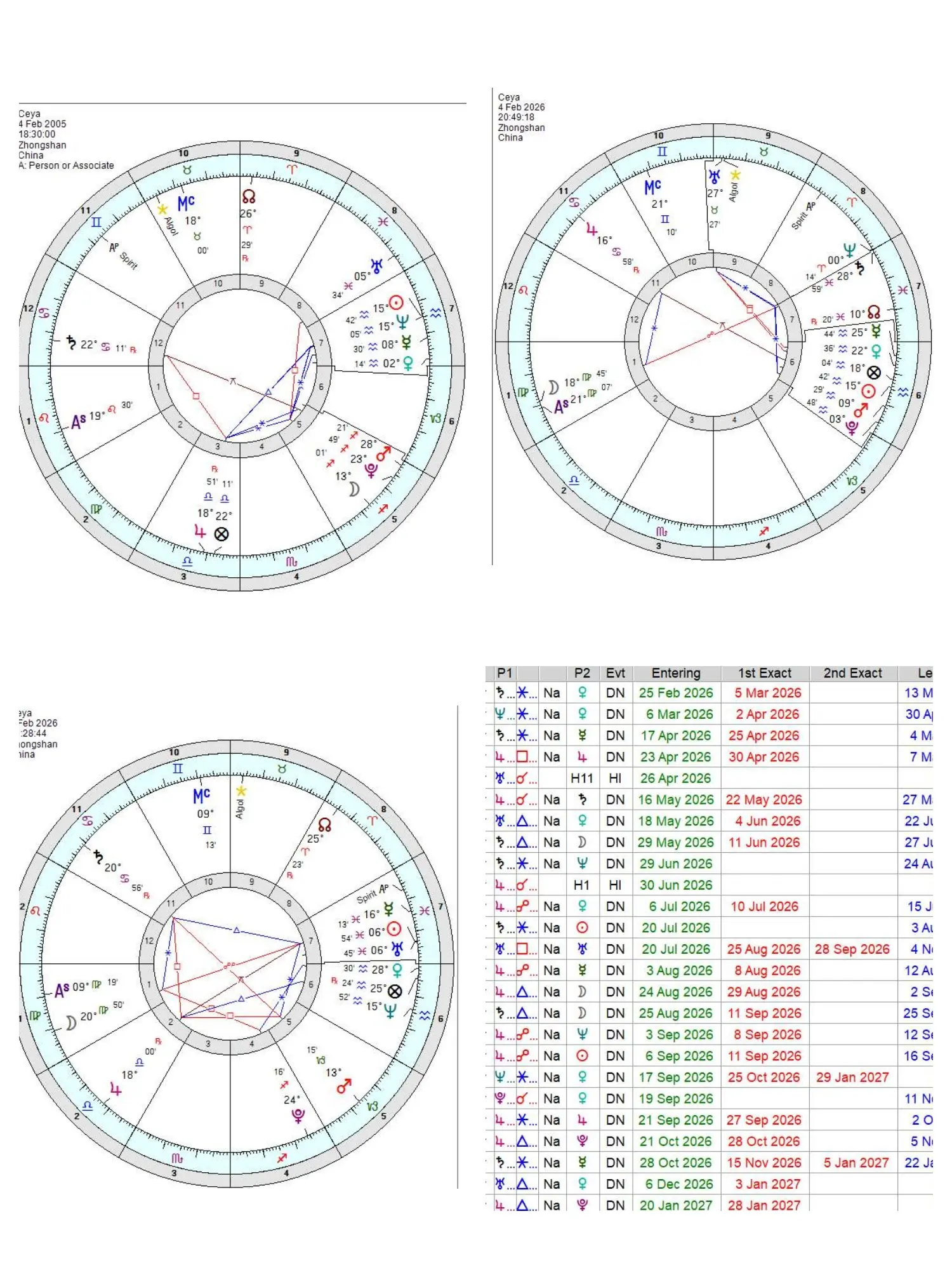
The images above display a Natal Chart, a Solar Return Chart, a Progressed Chart, and a Transit Calendar, respectively.
Her: "It's actually quite straightforward. You just have to remember that events promised in the Natal Chart can be triggered by Solar Returns, Secondary Progressions, and Transits. Planets in the Solar Return, Progressions, and Transits can activate the Natal Chart by forming aspects. Furthermore, Progressed planets can form aspects with Solar Return planets and transiting planets. Oh, and transiting planets can..."
Me: "Wait, hold on—"
Her: "Additionally, Eclipses can activate sensitive points in the Solar Return, Progressions, and Transits. A transit's promise might not deliver if the planet is Retrograde. The Progressed Moon carries significant weight for timing. And don't forget the influence of the major asteroids, and also..."
Enough. Please. No more
Let's put it this way: if I were using Zi Wei Dou Shu to predict "financial changes," I could give you an answer in five minutes. If I were using Tarot, who couldn't reply immediately when staring at a spread like the Five of Pentacles, Three of Swords, and The Tower?
But with modern predictive astrology, this one simple question requires you to generate three entirely distinct charts, cross-reference a massive ephemeris, and then stare at your computer screen for twenty minutes just to reach a tentative conclusion.
Ultimately, this incredibly cumbersome and convoluted procedure stems from the imprecision of any single modern predictive tool. Every student of astrology has heard the mantra: "Transits alone don't determine events. You must synthesize them with Progressions and Solar Returns, look for the 'Rule of Three,' and select the conclusion that appears most frequently across all methods."
The cross-referencing isn't even the most exhausting part. The real issue is that it gratuitously adds two new charts (Solar Return and Progressions) and a sprawling data sheet to your cognitive load. Setting aside the question of accuracy for a moment, if every single question requires such a significant investment of time, the energy cost of a single consultation becomes astronomical.
This is precisely why annual forecast reports on the market are generally far more expensive than natal chart readings, and it is the primary reason I abandoned most modern astrological techniques after two months of torment.
The predictive arts I respected were not like this. In the vast majority of traditional Chinese "命理术数" (Fate Theory), the predictive philosophy is consistent: The Natal Chart determines the overarching trajectory of a life, and timing techniques simply determine when these pre-written storylines are triggered.
You aren't asked to conjure two new charts out of thin air and toss a heap of new variables into a cauldron to see what chemical reaction occurs.
Does Western astrology truly lack such a technique?
Modern astrology, indeed, does not. But if we journey back two thousand years and gaze upon the brilliant night sky of ancient Greece, we can rediscover the true crown jewel of predictive astrology: Zodiacal Releasing.
So, What Exactly Is It?
Zodiacal Releasing is, without hyperbole, the most impressive and powerful predictive technique in Hellenistic astrology. For me personally, it has no equal. In fact, among all the divinatory systems I have studied, no single technique can compare to its combination of precision and convenience. It is, quite simply, #1.
Specifically, it employs a mechanical algorithm based on the Hellenistic Lots (often called Arabic Parts) to divide a person's life into distinct chapters. The content of these chapters is derived entirely from the promises of fortune and misfortune found in the natal chart itself.
Before we begin, we need to adjust a few basic technical settings. Let's use the chart of the renowned mathematician and astrologer Johannes Kepler as our example. I recommend you cast his chart using the birth data below or take a screenshot to follow along, which will greatly aid your understanding.
Step 1: Change the house system from Placidus to Whole Sign Houses. This is the default setting for Hellenistic astrology. It designates the entire sign of the Ascendant as the 1st house and assigns one sign per house sequentially, eliminating the confusing situation of intercepted signs or having multiple signs within a single house.
However, unlike purely classical astrology, we will be incorporating the Uranus, Neptune, and Pluto into our analysis.
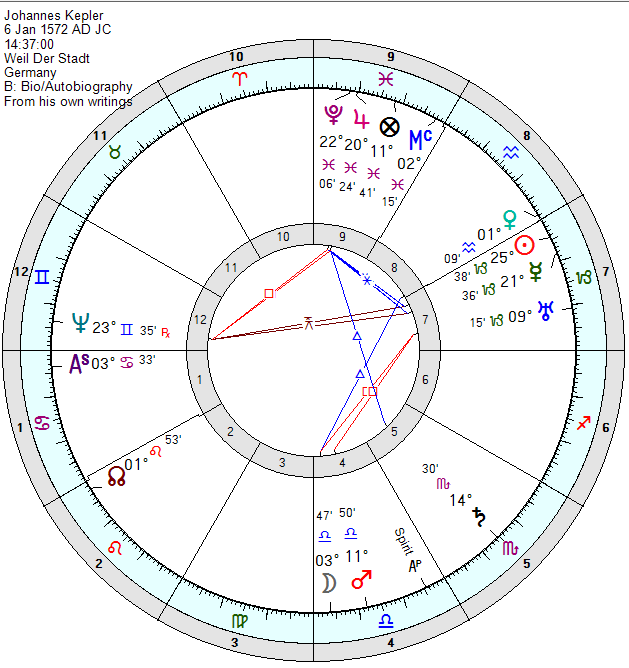
Step 2: Open a Zodiacal Releasing calculator on a site like Astro-Seek or in your preferred software . After entering the birth data, set "Release From" to the "Lot of Spirit."
This Lot governs the overall trajectory of one's life, career, and actions. While other Lots govern specific areas, using the Lot of Spirit alone is sufficient to make comprehensive and stunning predictions about life direction.
Step 3: If there is an option for release levels, choose up to L2(level 2) for now to keep things manageable. Set the calculation period to 100 years. After clicking "Calculate," you will generate a data table similar to the one below:
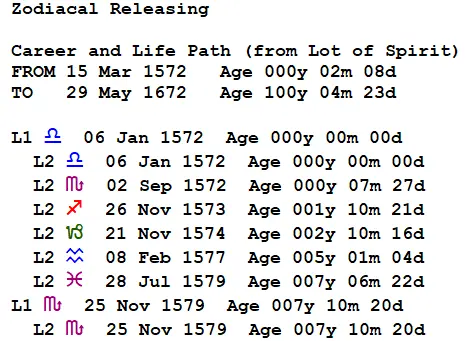
Place the natal chart and the data table side-by-side. Our basic setup is now complete.
Release Levels & Directing Signs
As shown in the data table, each line consists of a release level L1/L2, a specific zodiac sign, and a start date/age.
The release level represents the hierarchy of time periods. In Zodiacal Releasing, L1 corresponds to major life chapters (lasting years to decades), while L2 represents sub-chapters (months to years), and so on down to L4 (days). The sign listed next to the level is the Directing Sign for that period, meaning its energy takes the helm.
For Kepler, his first L1 period was directed from Libra, starting at birth and ending on November 25, 1579, when it switched to the Scorpio L1 period.
During this time, the house where Libra is located, the planets within it, and any planets in signs that form a hard aspect (conjunction, square, or opposition) to Libra are all activated.
In Kepler's case, Libra is in the 4th House, containing the Moon and Mars. Both are activated. Capricorn, which squares Libra, is also activated, along with its inhabitants: the Sun, Mercury, and Uranus. Therefore, the natal promises of these planets are brought to the forefront of his life.
The Moon is conjunct Mars and square Uranus. This is an extremely aggressive and volatile configuration. Mars-Uranus aspects typically signify sudden outbursts, accidents, and conflict.
The Moon represents inner emotions and the mother, and all of this occurs in the 4th House of family and roots. This indicates that during this L1 period, Kepler's home life was marked by sudden, violent disputes, which had a painful impact on his emotional state.
What are the historical facts? Kepler's father, Heinrich, was an extremely violent, crude, and belligerent mercenary. He was often absent from home, returning only suddenly and briefly between wars, creating a domestic atmosphere akin to a powder keg.
Furthermore, due to the poor condition of the Moon afflicted by a malefic Mars and an outer planet Uranus, which is also his Chart Ruler (Cancer Ascendant, ruled by the Moon), we can deduce that his physical vitality during this L1 period was very low.
History confirms this. Kepler was a premature baby, frail and sickly from a young age, with a severely compromised immune system. He often suffered from unexplained fevers, boils, and headaches. In 1576, at the age of four, he contracted smallpox, a disease that nearly killed him and permanently damaged his vision.

And that critical year, 1576, fell squarely within the Level 2 (L2) period of Capricorn (from Nov 1574 to Feb 1577)—the very sign housing Uranus, which squares his sensitive Moon.
Peak Periods
So far, we've covered the basic method for interpreting general L1/L2 periods. However, Zodiacal Releasing also features special phases whose importance and intensity far exceed that of ordinary periods.
As Vettius Valens, the 2nd-century Hellenistic astrologer who documented this technique, stated: when the directed sign falls in one of the angles relative to the Lot of Fortune, it marks the most effective, mentally active, and publicly prominent periods of the native's life.
In Kepler's chart, the Lot of Fortune is located in Pisces. The angular signs relative to Pisces are the 1st, 4th, 7th, and 10th signs from it: Pisces, Gemini, Virgo, and Sagittarius. When an L1 or L2 period enters one of these four signs, he enters a so-called Peak Period.
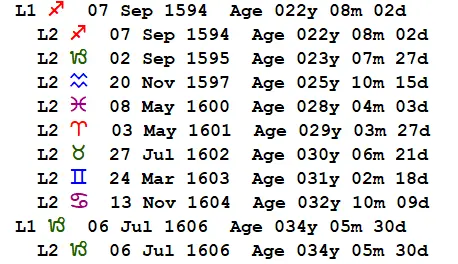
From September 1594 to July 1606, Kepler's L1 period was in Sagittarius, a Peak Period (10th from Fortune). Therefore, the activated planets—Neptune, Pluto, and Jupiter—and the promises of their respective houses were powerfully amplified.
Let's start with Jupiter, the most heavily aspected planet in this configuration. Jupiter is in its domicile in Pisces in the 9th house (higher learning/religion), already indicating a powerful potential for achievement in academic research.
It trines Saturn (ruler of the 7th house of marriage) and sextiles the Sun in the 7th house (which rules the 2nd house of resources). Jupiter signifies luck and expansion. Clearly, we can interpret this as a favorable configuration for gaining material support through marriage or partnerships.
The specific timing of these events is realized during the corresponding L2 periods. In 1594, during the Sagittarius L2 period, Kepler abandoned his initial ambition to become a pastor (a conflict shown by the square between Neptune in the 12th and Jupiter) and took a position as a mathematics teacher in Austria.
Between '94 and '95, he accurately predicted a harsh winter and an invasion, which brought him fame as an astrologer, granting him the social standing and income to support his astronomical research.
Then, from 1595-1597, the Capricorn L2 period activated his 7th house. In late 1595, Kepler met his first wife, Barbara Müller, the daughter of an extremely wealthy and influential mill owner. They married in early 1597. This marriage significantly improved his dire financial situation at the time, fulfilling the promise of Jupiter linking the 2nd and 7th houses.
But the story doesn't end there. Remember what we said earlier: a Peak Period represents the time when life's events manifest most effectively. This applies not only to promised fortunes but also to promised hardships.
We previously mentioned that Jupiter, in domicile in Pisces, has an oceanic capacity for expansion and magnification. And because the Lot of Fortune is also in Pisces, any L1/L2 period in Pisces is itself a Peak Period (1st from Fortune), increasing the rate of manifestation—for better and for worse.
Jupiter is conjunct Pluto within 2 degrees, an extremely challenging signature of upheaval, power struggles, and destruction. This is especially potent because this Jupiter is linked to both wealth (Sun, ruler of 2H) and marriage (Saturn, ruler of 7H). Furthermore, it squares Neptune in the 12th house, representing spirituality, religion, and sacrifice.
In 1600, during the Pisces L2 period, the Counter-Reformation swept through Austria, demanding that all Protestants convert to Catholicism. Kepler was expelled from Austria for refusing to convert, fleeing to Prague and losing his career, reputation, and his wife's property.
What is most chilling is that in 1611, the exact same scenario literally repeated itself. The Counter-Reformation movement in Prague intensified, pressuring him to convert to Catholicism to keep his official post.
He refused again and was forced to move to a provincial town. That same year, tragedy struck harder: his beloved six-year-old son died of smallpox, and his wife Barbara passed away from typhus, compounded by grief.
What was the L2 period active in 1611?
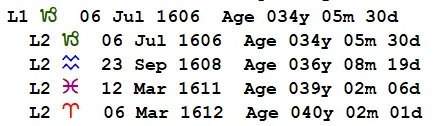
Yes. Pisces.
The Loosing of the Bond (LB Period)
This is the final critically important concept in Zodiacal Releasing. The "Loosing of the Bond" (LB) occurs within specific long L1 periods. It is triggered when the L2 sub-periods have cycled through all twelve signs. When it's time to return to the starting sign, the sequence breaks; instead of restarting, the release jumps to the sign opposite the L1 directing sign.
For example, during Kepler's Capricorn L1 period (which began in 1606), the L2 periods started from Capricorn and proceeded counter-clockwise (Capricorn → Aquarius → Pisces...). After completing the entire cycle and finishing Sagittarius, the next L2 period did not restart at Capricorn. Instead, it jumped to Capricorn's opposite sign, Cancer.
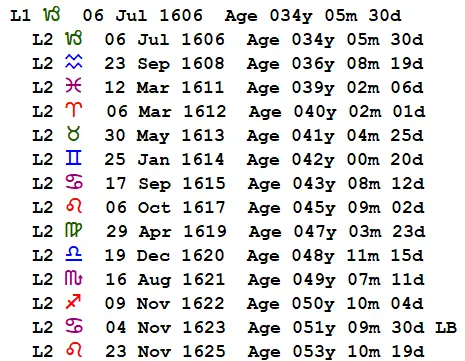
Note: Most ZR software will explicitly mark this as "LB" or "Loosing of the Bond."
Due to the mathematical time it takes for L2 to cycle through twelve signs, only L1 periods in Gemini, Cancer, Leo, Virgo, Capricorn, and Aquarius are long enough to feature a Loosing of the Bond.
The LB period has a distinct, almost disruptive quality. When it occurs, an event will take place that represents a 180-degree turn or a major pivot in the narrative promised by the L1 period. For instance, if the L1 period has been defined by entrapment or stagnation, the LB period often brings liberation. If the L1 has been about public visibility, the LB might trigger a sudden withdrawal.
However, a general "pivot" is too vague for precise prediction. To understand the exact nature of this turn, we look at what happened during the first L2 period of that same sign earlier in the L1 cycle. This is technically called the Pre-LB period.
For example, if your LB period occurs in Cancer, look back to the first time the Cancer L2 period occurred within that L1 chapter. The events of that time often provide the clues that will happen during the LB.
Let's return to Kepler's chart one last time. During his Capricorn L1 period, the same difficult planets from his childhood (Sun, Mercury, Uranus, Mars, Moon) were reactivated, pointing to continued family hardship.
We will sorrowfully bypass the details of him losing his mother, wife, son, and daughter during these years, and focus instead on his professional life.
The Moon, Sun, and Mercury rule his 1st (Self), 2nd (Resources), and 3rd (Communication) houses. Jupiter, sextile the Sun and Mercury, rules the 9th house of higher knowledge and publishing. However, the Pluto conjunction to Jupiter and the Mars/Uranus square inject themes of haste, frustration, intense pressure, and breakdown into these areas.
Thus, this L1 period tells a story of relentless academic output in an extremely difficult environment. Although he was one of the most famous astronomers in Europe, he often went hungry due to the Emperor's unpaid wages and frozen assets.
The anomalous data on Mars's orbit tormented him for years, and the hundreds of pages of manual calculations he performed nightly caused him immense physical and mental suffering.
In 1615, during the Cancer L2 period—his Pre-LB—he published Nova Stereometria Doliorum Vinariorum, a foundational work in mathematics. In it, he was the first to use the concept of infinitesimals as a practical tool, effectively opening the door to calculus.
Despite its historical significance, this book was essentially a side project at the time—a mathematical diversion. As an astronomer, this research did not immediately alleviate the crushing burden of his daily astronomical calculations.
However, when he reached the actual Cancer LB period (November 1623 to November 1625), this seed bore fruit. He perfected and popularized one of the greatest tools in the history of astronomy: logarithms.
He was instrumental in making this tool accepted by scientists across Europe. As Pierre-Simon Laplace later famously remarked, "The invention of logarithms, by shortening the labors, doubled the life of the astronomer."
It was precisely this invention that brought an end to the tedious, soul-crushing calculations that had defined his L1 period. In 1627, shortly after the LB, he published the Rudolphine Tables, the most accurate astronomical ephemeris for nearly a century.
The "mathematical side project" from his Pre-LB period did indeed foreshadow the massive 180-degree turn in his career during the LB: a shift from being a slave to calculation to becoming the master of it.
In Conclusion
We have now covered the core pillars of Zodiacal Releasing. And though I call them "fundamentals," with just the logic of L1/L2 periods, Peak Periods, and the Loosing of the Bond, we have successfully traced the intricate fate of Johannes Kepler—a man who famously claimed that "the stars incline, but do not compel," yet whose life seemed to march perfectly to his chart.
This demonstrates the sheer power of this Hellenistic jewel. With just a basic understanding of planetary natures and a little familiarity with this method, you too can make predictions of this caliber.
I hope this guide has been illuminating. If you're interested in more deep dives like this, feel free to leave your email to subscribe to my future research.
Thanks for reading.