ADHD Research

Tag:
Unaspected, Critical Degree, House Ruler, Stellium, Mutual Reception
Author: Ori Olwardt
Beginning…
“Do you ever find your mind wandering uncontrollably?”
“Oh, all the time. I have ADHD. Just to procrastinate properly at work, I need to have at least three browser tabs open at once…”
As an astrologer, I'm hearing conversations like this more and more in my client consultations. As an astrologer specializing in predictive techniques, I've noticed a recurring set of specific chart patterns among clients who either describe struggles with inattention and hyperactivity, or who have a formal ADHD diagnosis.
This pattern caught my attention. If astrology can offer insights into our psychological motivations and behavioral traits, could it be that the unique behavioral patterns of the neurodivergent (ND) community are also encoded in the birth chart?
This question led me to conduct a more systematic, cross-referencing study. Using the diagnostic criteria from the DSM-V as a benchmark, I analyzed dozens of charts to identify and synthesize their common astrological signatures.
The results were compelling: several distinct astrological archetypes repeatedly emerged that align closely with the ADHD profile.
This article serves as the preliminary notes from my research. Over the next 15 to 20 minutes, we will explore in detail how astrology illustrates these traits through its symbolic language.
I’ve structured the core patterns I observed around the two main categories of traits defined in the DSM-5: the first group relates to Inattention, and the second to Hyperactivity and Impulsivity.
It is crucial to emphasize that this article is not a substitute for a professional medical diagnosis. It is intended solely for astrological research and personal insight.
If you find that your chart aligns with the traits described below and these tendencies are causing difficulties in your life, I sincerely encourage you to take a few minutes to complete a professional self-report scale (like the ASRS) and seek the support you may need.
A: Inattention
Within the nine criteria for "Inattention" in the DSM-5, I've grouped them into two primary behavioral clusters:
The first cluster involves the direct loss of attentional control, corresponding to criteria A1 (fails to give close attention to details), A2 (has difficulty sustaining attention), A3 (does not seem to listen when spoken to directly), and A8 (is easily distracted by extraneous stimuli).
The second cluster points to a significant deficit in organization and discipline, such as A4 (fails to finish schoolwork, chores, or duties), A5 (has difficulty organizing tasks and activities), A6 (avoids tasks requiring sustained mental effort), A7 (loses things necessary for tasks), and A9 (is forgetful in daily activities).
It's also worth noting that many researchers point out that the flip side of this attentional dysregulation is often the extraordinary imagination and remarkable creativity found in individuals with ADHD.
Synthesizing these two core challenges (attentional drift, executive dysfunction) with one potential gift (creative imagination), I have identified three highly correlated astrological patterns:
1. Attentional Deficits & Non-Linear Thinking: Mercury/3rd House, Uranus, and Jupiter
Mercury and the 3rd House together form the operating system of our mind, responsible for processing logic, information, and linear communication.
When these two are in aspect with Uranus (disruption, sudden change) and Jupiter (expansion, digression, leaping), the smooth, linear flow of thought is constantly "interrupted" or "scattered."
This makes it difficult to sustain focus on a single point. Note that a powerful Uranus or Jupiter in the 3rd House carries nearly the same meaning as the ruler of the 3rd House (the planetary ruler of the sign on the 3rd house cusp) being aspected by them.
2. Organization and Discipline: Saturn
This is, of course, the domain of Saturn, the planet of rules, structure, and patience. When Saturn is heavily afflicted, in a difficult position, or—most notably—forms hard aspects (like squares or oppositions) with planets like Uranus, the Sun (personal will), or Mars (drive and execution), the sense of responsibility and the ability to translate ideas into organized action can become compromised.
3. Boundless Imagination: Neptune
If Mercury and the 3rd House seek clear boundaries and solid logic, Neptune is a boundless ocean of dreams, inspiration, and intuition.
When Neptune's energy seeps into the mental faculties, the "solid ground" of logic is surrounded, or even submerged, by the "waters" of intuition, imagination, and artistic sensibility. Interestingly, the most common aspects I've observed here are conjunctions and trines, with squares, oppositions, and sextiles being less frequent.
Case Study 1: Leonardo da Vinci
Let's start with Leonardo da Vinci. This Renaissance master is as famous for his genius as he is for his notorious procrastination and the vast number of unfinished masterpieces he left behind.
His case is so compelling that scholars have even posthumously diagnosed him with ADHD. Unsurprisingly, his astrological chart clearly reflects many of the classic signatures we've discussed.
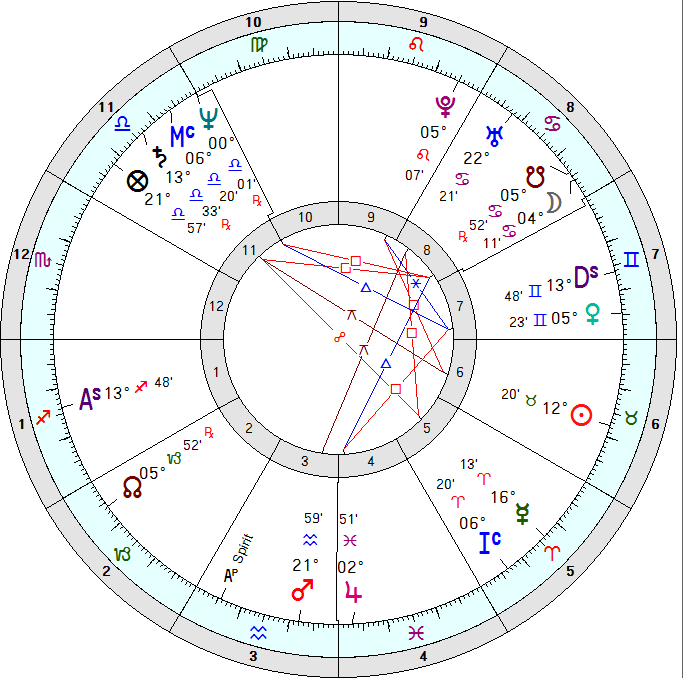
Attentional Deficits & Non-Linear Thinking
Mercury square Uranus: This is a quintessential aspect for non-linear thinking. The logical fluency of Mercury is constantly disrupted and revolutionized by the "lightning bolts" of Uranus.
For him, thought likely wasn't a continuous line but rather a collection of disconnected, genius-level "fragments of inspiration."
The 3rd House Cusp in Aquarius: With Aquarius on the 3rd house cusp, Saturn becomes a co-ruler of his mental processes. In his chart, we find a precise opposition between Mercury, the planet of thought, and Saturn, the structure-oriented ruler of this house.
This symbolizes a tremendous internal tug-of-war between two opposing modes of thinking: on one hand, the spontaneous, leaping insights (Mercury), and on the other, slow, structured deliberation (Saturn). This constant inner conflict would have consumed a significant amount of his mental energy.
Organization & Execution
Sun quincunx Saturn: In astrology, the quincunx aspect signifies a persistent tension that requires constant adjustment but is never perfectly resolved.
Here, it suggests that his core identity and willpower (Sun) were fundamentally at odds with rules, discipline, and structure (Saturn). For him, adhering to a plan or a set of rules would have felt like an unbearable constraint and source of pressure.
Mars quincunx Uranus: Mars represents our drive and ability to execute. This aspect points to a strong sense of disharmony between his desires (Mars) and his innovative thinking (Uranus).
This perfectly mirrors the common ADHD experience where executive function is fragmented, constantly chasing the newest stimulus rather than sustaining energy on a single project.
Imagination & Artistic Drive
His Neptune is located at a precise 00°01' of Libra. This initial degree, known as a critical degree, signifies a powerful, pure, yet raw and untamed energy. It injects Neptune's dreamlike and spiritual qualities into the pursuit of "beauty" and "harmony" (Libra) in the most extreme way.
Crucially, this Neptune also forms a trine to Venus, the ruler of Libra. This clearly points to his extraordinary artistic genius, as well as a Neptune-driven, clumsy pursuit of an ethereal "perfection" that likely left him perpetually dissatisfied with his own work.
B: Hyperactivity & Impulsivity
The DSM-5's criteria for hyperactivity and impulsivity can also be broadly divided into two categories:
The first is physical hyperactivity in the traditional sense, including B1 (fidgets or squirms), B2 (leaves seat when remaining seated is expected), B3 (runs about or climbs in inappropriate situations), and B4 (is unable to play or engage in leisure activities quietly).
The second category relates to mental impulsivity, such as B5 ("feeling as if 'driven by a motor'"), B6 (talks excessively), B7 (blurts out an answer before a question has been completed), B8 (has difficulty waiting their turn), and B9 (interrupts or intrudes on others).
The Role of Mars: The Internal Accelerator
In astrology, Mars is our internal "accelerator," representing our desires, actions, and drive. Its condition in the chart directly influences how we expend our energy. Interestingly, different challenges involving Mars can lead to different ADHD-related traits:
When Mars is obstructed or inhibited (e.g., being combust by the Sun, or forming difficult aspects with Saturn or Neptune), an individual's drive may be weakened, making them more prone to executive dysfunction—the feeling of "wanting to do it but lacking the energy."
Conversely, when Mars is overpowering and unchecked (e.g., located at a critical degree, or forming hard aspects with powerful planets like Jupiter or Pluto), it can manifest as intense impulsivity—the tendency to "act first, think later" and an inability to wait.
Case Study 2: An Anonymous Client
To understand this more concretely, let's examine the chart of an anonymous client. This individual has long struggled with intense emotional volatility and impulsive behaviors. When we look at their chart, a dramatically emphasized Mars immediately stands out.
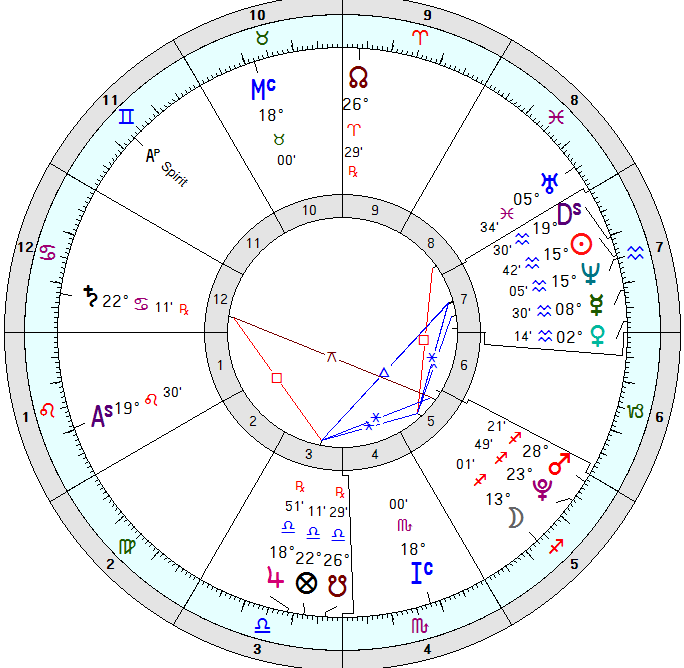
First, Mars itself is in a high-pressure position. It is located at 28° Sagittarius, a "critical degree," which suggests that the planet's energy will erupt in an unstable or even extreme manner.
Second, Mars is "supercharged" by two powerful planets. It is in a tight conjunction with Pluto, the planet of depth and ultimate power, which imbues their desires and anger with a profound, intense quality.
At the same time, the Moon, representing emotions, joins this configuration, forming a potent Moon-Mars-Pluto stellium.
This stellium is in the 5th House (romance, creativity). This explains why the client described themselves as someone who "falls in love very easily."
Their powerful emotional and desiderative energy, driven by the Moon-Mars-Pluto trio, is channeled most directly into the realm of romance. This is also a clear manifestation of "mental impulsivity" in a specific area of life.
Finally, we see the signal of a lack of control. Pluto, a key player in this stellium, forms a quincunx aspect with Saturn, the planet of order and rules. As mentioned before, this is an aspect of "poor coordination."
While we don't typically prioritize aspects between generational planets (Pluto) and outer planets (Saturn), it becomes critically important here because Pluto has been activated by personal planets (the Moon and Mars).
This aspect paints a clear inner picture: a powerful, emotionally-driven impulse (the Moon-Mars-Pluto stellium) is in constant, irreconcilable conflict with the internal sense of order and rules. This is the core dilemma behind many impulsive traits.
C: Subclinical Markers
Beyond the official diagnostic criteria, there are several traits widely recognized within ADHD academic research and community observations as core features, even if they haven't yet been included in clinical guidelines. Exploring these "subclinical markers" can deepen our understanding of the inner world of individuals with ADHD. Here, we will focus on two key traits.
1. Rejection Sensitive Dysphoria (RSD)
RSD is perhaps the most likely candidate for inclusion in the future DSM-6. In simple terms, it refers to the disproportionate and extremely intense psychological, or even physical, pain that individuals with ADHD experience in response to perceived rejection, criticism, or failure.
In astrology, this extreme emotional sensitivity almost always points to an "overwhelmed" Moon in the birth chart. This "overwhelm" doesn't just come from hard aspects. Sometimes, a Moon that is aspected by too many planets—regardless of whether they are traditionally "good" or "bad"—can become more fragile and pained simply by receiving too many conflicting energy signals.
For example, the inner suffering of someone with a Moon trine the Sun and Venus, but also in a challenging aspect to Pluto, is often far more complex and profound than that of someone with a simple Moon-Pluto square, because the former involves a much more life domains of the self.
Generally, a propensity for RSD is indicated when the Moon meets one or more of the following conditions:
It has numerous aspects (typically interacting with 3 or more planets).
It is unaspected or at a critical degree.
It is in a sensitive water sign.
It has at least one hard aspect from an outer planet.
2. A Relentless Curiosity & Drive for Exploration
Another prominent trait is an insatiable curiosity, which is linked to the unique dopamine reward system in the ADHD brain. In astrology, this persistent thirst for the unknown, for truth, and for distant horizons is highly correlated with the energies of Sagittarius, the 9th House, Jupiter, and Uranus.
Case Study 3: Carl Sagan
Famed astronomer Dr. Carl Sagan was renowned for his relentless curiosity, his expansive, cross-disciplinary thinking, and his staggering output (he wrote over 600 papers and 20 books in his lifetime).
His ADHD traits are evident in both his biography and his chart, where the patterns we've discussed can also be found. Here, we will focus on his Moon to see how it wonderfully illustrates both the sensitive downside of RSD and the upside of a powerful exploratory drive.
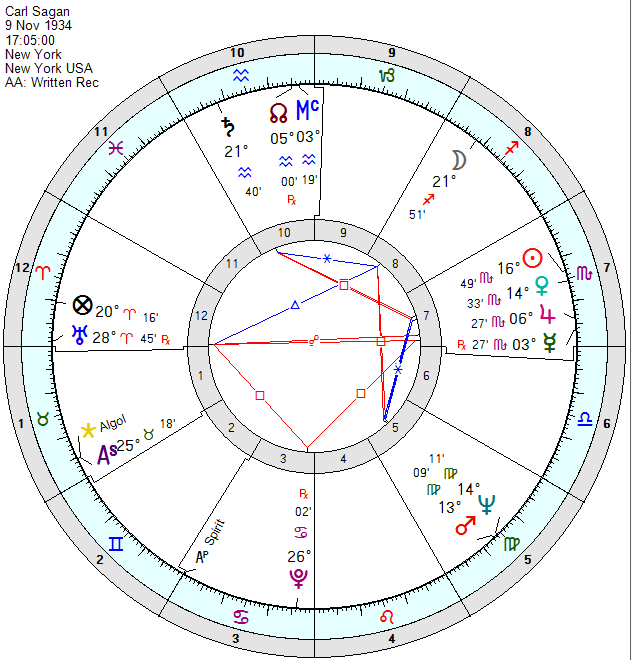
The 3rd House is in Cancer, which means the Moon, representing his inner emotions and needs, becomes the chief commander of his mental framework. And this "commander" Moon happens to be located in the exploration-driven sign of Sagittarius.
This Moon in Sagittarius forms a harmonious trine with Uranus, which is at a critical degree of 28° Aries. His emotional needs (Moon) were naturally and fluently integrated with the energies of intellectual pursuit (Sagittarius), breakthrough innovation (Uranus), and a pioneering spirit (Aries). This explains his tireless spirit of scientific exploration.
However, this very same Moon was also the source of his pain. In addition to the trine with Uranus, his Moon is also aspected by Saturn, Mars, and Neptune, connecting it to nearly half the planets in his chart.
The square from the Mars-Neptune conjunction, in particular, points directly to the emotional stress (Moon) brought on by the combination of action (Mars) and chaos/confusion (Neptune).
This fully explains his extremely low tolerance for frustration and profound inner suffering in the face of criticism and challenges.
It is well-known that Carl Sagan was a prominent critic of astrology. And here we are, using the very language he decried to analyze the profound inner workings of his mind—patterns he himself may never have fully understood. The dark humor and irony in this situation are simply too rich to ignore.
Case Study 4: Albert Einstein
In any discussion of celebrity cases of ADHD, Albert Einstein is an unavoidable name. His unkempt appearance, incredible capacity for hyperfocus, and notoriously poor daily planning skills all make him seem like the poster child for ADHD.
So, what does his birth chart have to say? At first glance, we can spot some convincing signs:
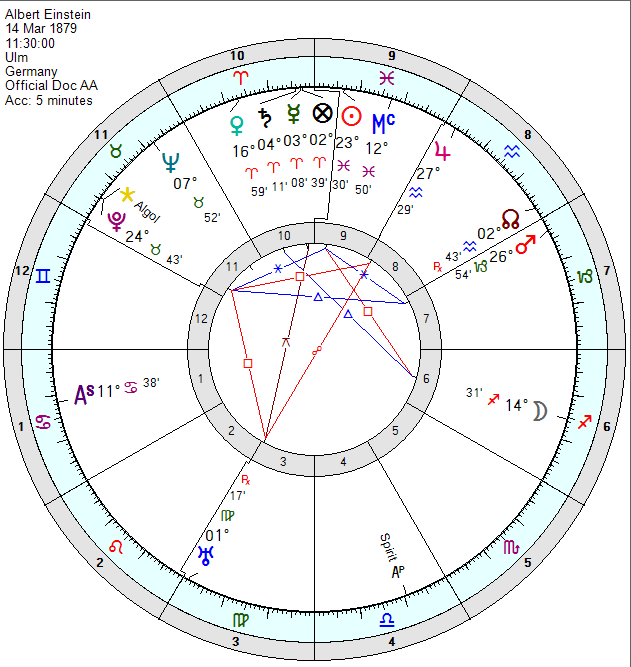
Observing his 6th House of daily routines, the Moon resides there in a trine to Venus in the 10th House. Venus, the ruler of the balanced and orderly sign of Libra, is in its detriment in Aries.
This suggests that the energy of a "distorted," imbalanced planet was smoothly channeled into his daily life (6th House Moon), which seems to explain his chaotic self-management skills.
His 3rd House of the mind contains Uranus, the planet of sudden change and inspiration, positioned at a critical 1° of Virgo. Furthermore, with a Cancer Ascendant, the Moon—ruler of Cancer and thus his chart ruler—is located in the explorative sign of Sagittarius. These placements strongly point to an extraordinary associative ability and a deep-seated desire for exploration.
It certainly looks like a typical ADHD configuration. However, if we dig deeper, we find more substantial—and more central—evidence that overturns our initial hypothesis.
Although Uranus brings flashes of inspiration to his 3rd House, the primary ruler of that house is Mercury. This Mercury is in a tight conjunction with Saturn, the planet of order and structure, while forming an "uncomfortable" quincunx aspect with Uranus.
This paints a clear inner picture: his mind (Mercury) was fundamentally inclined towards order and structure (conjunct Saturn) and felt resistant to sudden, disruptive changes (quincunx Uranus). This is fundamentally different from the ADHD brain's inner drive to embrace chaos and seek novelty.
His Mars is in its exaltation in Capricorn, an extremely powerful and disciplined placement. This Mars is not only in good condition, sextiling the Sun, but it also forms a "Mutual Reception" with Saturn, which is also in a powerful position in Aries. Both planets are also in angular houses—a strong and fortunate configuration.
This signifies that his capacity for action (Mars) and his ability to structure (Saturn) were mutually supportive and could work together with high efficiency. This completely contradicts the core trait of executive dysfunction in ADHD.
The absence of the core RSD experience: His Moon does not exhibit the kind of "overwhelmed" aspect pattern we discussed earlier.
A simple Sun-Moon square points more towards a conflict between the inner self and emotions, but it falls far short of the catastrophic cycle of extreme sensitivity to external criticism that defines the ADHD emotional experience.
In summary, Einstein's chart does not present the core signatures of ADHD that we have outlined. On the contrary, the chart is more inclined to depict a gifted individual who was inwardly conservative and resistant to change.
This astrological conclusion aligns with the shift in academic understanding of Einstein in recent years. Researchers now tend to see him as a combination of Atuism and Giftedness.
His trademark unkemptness and disregard for social conventions are classic ASD traits, while his curiosity is a trait shared by both gifted individuals and those with ADHD—but as our detailed analysis has shown, we have ample reason to rule out the latter.
This demonstrates that astrological analysis is far from simple pigeonholing. It is a profound practice that requires nuanced discernment and rigorous verification, with the potential not just to apply labels, but to reveal the unique and complex psychological architecture of an individual.
Afterword…
This brings us to the end of this article. We have systematically explored the strong correlations between core ADHD traits and specific astrological patterns, covering the archetypes of inattention (Mercury/3rd House), impulsivity (Mars), emotional sensitivity (the Moon), and the drive for exploration (Uranus/Jupiter).
I hope this piece is helpful for researchers and personal explorers interested in this topic. If you're interest in my research, feel free to subscribe with your email.
Thanks for reading.